In today’s fast-paced digital economy, the “digital divide” is no longer just about access to the internet; it is about the ability to leverage enterprise-grade technology to drive efficiency. Historically, powerful computing infrastructure was the exclusive domain of large corporations with massive IT budgets. However, the democratization of cloud computing has fundamentally shifted this landscape. For small and medium enterprises (SMEs), cloud technology has become the great equalizer, offering affordable, scalable, and secure solutions that were once financially out of reach.
For the modern SME, adopting cloud computing is not merely an IT upgrade—it is a strategic necessity. By shifting from traditional, on-premise hardware to cloud-based services, businesses can eliminate barriers to growth, foster remote collaboration, and ensure operational resilience.
The Economic Argument: Shifting from CapEx to OpEx
The primary hesitation for many SME owners regarding technology is the high upfront cost of server hardware, specialized maintenance, and physical security. Cloud computing flips this model by transforming capital expenditure (CapEx) into operating expenditure (OpEx).
Financial Advantages of Cloud Adoption
| Feature | Traditional On-Premise | Cloud-Based Model |
| Upfront Cost | High (Server/Hardware purchase) | Low/Zero (Subscription based) |
| Maintenance | Costly (Internal IT staff required) | Included in provider service |
| Scalability | Rigid (Must buy new hardware) | Instant (Adjust plan as needed) |
| Risk | High (Hardware failure/theft) | Low (Distributed redundancy) |
By paying only for the resources used—the “pay-as-you-go” model—SMEs protect their cash flow. There is no need to over-provision hardware “just in case” of a spike in demand; instead, resources can be scaled up or down instantly, ensuring that the business only pays for what it actually consumes.
Core Cloud Solutions for the Modern SME
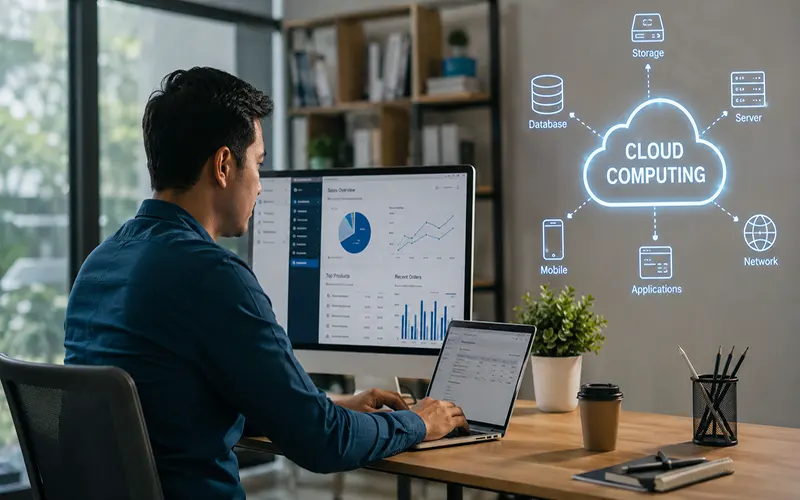
Cloud computing is a broad ecosystem. For the average SME, the most impactful solutions generally fall into three key categories:
1. Infrastructure as a Service (IaaS)
IaaS allows businesses to rent virtualized computing resources over the internet. Instead of buying physical servers, SMEs can utilize platforms like AWS, Microsoft Azure, or Google Cloud. This provides the power to host custom applications, complex databases, or development environments without the overhead of physical hardware management.
2. Software as a Service (SaaS)
This is the most common entry point for SMEs. SaaS provides fully functional software applications delivered over the web. Examples include Microsoft 365 or Google Workspace for productivity, Salesforce or HubSpot for Customer Relationship Management (CRM), and QuickBooks Online for accounting. These tools replace localized, outdated software, ensuring all employees use the same version and data is synced in real-time.
3. Cloud Storage & Backup
Data is the lifeblood of a business. Cloud storage services (such as Dropbox for Business, OneDrive, or specialized backup solutions like Backblaze) ensure that critical business documents are stored off-site. In the event of a local disaster—such as a fire, theft, or hardware failure—a company’s data remains intact and accessible from any location.
Addressing SME Hesitations
Despite the clear benefits, some SME owners remain cautious. Their primary concerns usually center on security, data control, and the “skills gap.”
- Security: Contrary to popular belief, major cloud providers typically offer significantly higher levels of physical and digital security than the average small office can afford. By utilizing enterprise-grade encryption and automated security patching, reputable providers often reduce the risk of data breaches.
- Data Control: Modern cloud agreements provide transparent terms regarding data ownership. Companies should choose providers that comply with relevant data protection regulations (such as GDPR or CCPA).
- The Skills Gap: SMEs often worry they lack the expertise to manage cloud environments. The beauty of modern SaaS and managed cloud services is that they are designed for non-technical users. Providers offer intuitive dashboards, and the vast majority of the heavy technical lifting is handled by the vendor, not the business owner.
Practical Implementation Roadmap
Transitioning to the cloud does not need to be an overnight overhaul. Follow this three-step roadmap to minimize disruption:
- Audit and Prioritize: Identify the “pain points” in your current workflow. Are employees struggling with file access? Is accounting software outdated? Start with the area that will yield the highest immediate return on investment.
- Pilot Test: Choose one department or one specific function to move to the cloud. For instance, migrate document collaboration to Google Workspace. Evaluate the ease of use, cost, and efficiency gains before moving on to core infrastructure.
- Establish Governance: Even in the cloud, security is a shared responsibility. Ensure you enforce Multi-Factor Authentication (MFA) for all employees and establish clear protocols for who has access to sensitive business data.
For small and medium enterprises, the cloud is no longer a luxury—it is the foundation for future-proofing your business. By shifting costs to a manageable, subscription-based model and leveraging the immense power of remote infrastructure, SMEs can focus their energy on what truly matters: innovation, growth, and serving their customers. Cloud adoption is an investment in your business’s agility, providing the tools necessary to compete in a rapidly evolving market. Start small, scale thoughtfully, and reap the benefits of a modern, efficient enterprise.