

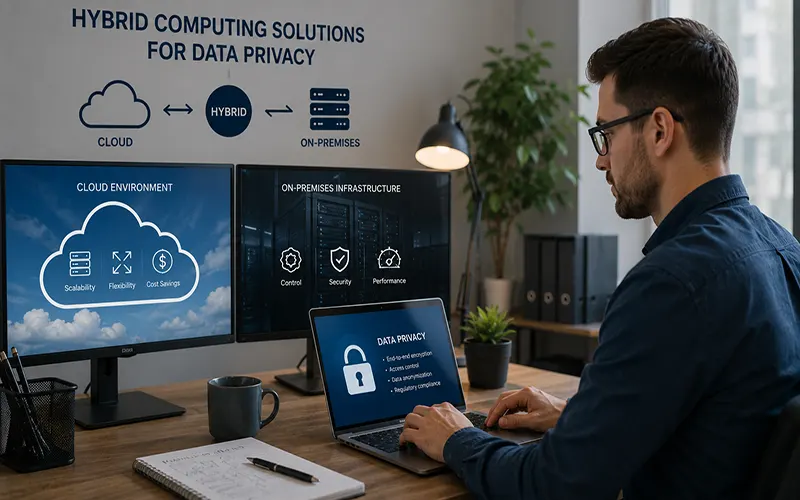
In the 2026 digital landscape, the “Hybrid Paradox” has become the defining challenge for enterprise IT: organizations must leverage the elastic scalability of the public cloud while maintaining absolute control over the sensitive, privacy-regulated data that drives their competitive advantage. As cloud costs become increasingly volatile due to AI workloads and micro-charges, the hybrid model has evolved from a transitional phase into a long-term strategic necessity.
The Strategic Advantage of Hybrid Privacy
The modern approach to hybrid computing is built on workload placement discipline. Rather than a “cloud-first” or “on-prem-first” mandate, IT leaders are now mapping applications based on their sensitivity, performance requirements, and data residency needs.
By keeping core datasets, proprietary IP, and PII (Personally Identifiable Information) on private, controlled infrastructure—such as a private cloud or a secure colocation facility—businesses minimize their exposure to public cloud breaches and jurisdictional legal hurdles. Simultaneously, non-sensitive workloads—like development environments, web front-ends, and bursty analytical tasks—are offloaded to public clouds. This strategy not only tightens data privacy but also shields the budget from the unpredictable egress fees and premium charges associated with high-bandwidth public cloud storage.
Core Components of Cost-Effective Hybrid Privacy
To implement a cost-effective hybrid strategy, enterprises must move beyond simple virtual machine management toward a unified, automated architecture.
1. Unified Orchestration with Containerization
Using abstraction layers like Kubernetes (K8s) is essential. By containerizing applications, you gain the ability to deploy the same software stack across both private and public environments. This eliminates the “months of refactoring” that typically drives up technical debt and vendor lock-in, allowing you to move workloads to whichever environment offers the most favorable price-performance at any given moment.
2. Intelligent Data Tiering
Not all data requires high-performance, expensive storage. Implement automated lifecycle policies that move inactive sensitive data to cold, secure private storage. By utilizing object storage for backups and archiving, you reduce your reliance on expensive public cloud storage tiers, keeping your long-term storage costs predictable and your data within your sovereign control.
3. Consistent Security via Encryption and Tokenization
In a hybrid model, data privacy must be platform-agnostic. Implement tokenization and encryption protocols that stay with the data regardless of whether it resides in a private cluster or a public instance. By managing your own encryption keys (using a centralized Key Management Service), you ensure that even if a public cloud provider is compromised, your sensitive information remains unreadable and secure.
Optimizing the Total Cost of Ownership (TCO)
The goal of hybrid architecture is to balance performance with fiscal efficiency. In 2026, the following strategies have become industry standards for maintaining a lean hybrid budget:
- Avoid Vendor Lock-in: Use open-source tools (Terraform, OpenCost, Kubernetes) to remain vendor-agnostic. This maintains your negotiating leverage with hyperscalers and prevents “egress traps,” where high data transfer fees effectively ransom your data.
- Resource Balancing: Deploy stateless workloads on “Spot” or “Preemptible” public cloud instances. These offer discounts of up to 90% compared to on-demand pricing and are ideal for batch processing or testing, while keeping your stable, “always-on” baseline workloads on your private, predictable hardware.
- Infrastructure-as-Code (IaC): Automating the deployment of your hybrid environments reduces manual labor, eliminates human configuration errors, and allows you to “hibernate” entire non-production environments during off-hours, further cutting compute costs by 50–70%.
Hybrid Privacy Readiness Checklist
Before proceeding with your hybrid deployment, ensure you have addressed the following:
- Data Classification Taxonomy: Have you identified which workloads are “sensitive” (private cloud) vs. “commodity” (public cloud)?
- Data Residency Compliance: Does your private infrastructure meet local legal requirements for data localization?
- Encryption Key Management: Do you retain full control over your encryption keys, or are they managed by a third-party cloud provider?
- Unified Visibility: Can you monitor costs and security posture across both environments from a single dashboard (e.g., using OpenCost or a CSPM tool)?
- Latency Requirements: Have you verified that your network interconnects (e.g., Direct Connect or ExpressRoute) can handle the traffic between your private and public instances without incurring prohibitive egress costs?
Private vs. Public vs. Hybrid: The Cost-Security Matrix
| Environment | Data Control | Scalability | TCO Predictability | Best For… |
| Private | Maximum | Limited | High (Stable) | Core IP, sensitive PII, predictable AI inferencing |
| Public | Low/Shared | Extreme | Low (Volatile) | Innovation, dev/test, elastic spikes |
| Hybrid | High (Balanced) | High | Balanced | The “Modern Enterprise” standard |
Hybrid computing is no longer a stopgap measure; it is the “middle ground” for the modern enterprise. By aligning workload placement with security needs, utilizing container-based portability to avoid vendor lock-in, and automating your resource management, you create a system that is both secure enough for your most private data and scalable enough for your most ambitious growth. In 2026, privacy and cost-efficiency are not competing goals—they are the two pillars of a sustainable digital infrastructure.