
In 2026, the traditional corporate “perimeter”—the firewalled office building—has effectively dissolved. With the workforce distributed globally, the new reality is a distributed perimeter. Securing this environment requires a departure from legacy network-based security toward cloud-native, identity-centric architectures. For business leaders, selecting a secure cloud solution is no longer a technical choice; it is a fundamental operational necessity to ensure resilience against an evolving threat landscape.
The Shift from VPN to Zero Trust
For decades, Virtual Private Networks (VPNs) were the standard for remote access. They functioned like a gatekeeper: once you were inside the gate, you had broad access to the “trusted” network. This model is now obsolete. If a single remote endpoint is compromised, an attacker can move laterally across the entire network to reach sensitive data.
Modern remote teams must adopt Zero Trust Network Access (ZTNA). Built on the core principle of “Never trust, always verify,” ZTNA assumes that threats exist both inside and outside the network. Instead of connecting a user to a network, ZTNA connects a user directly to a specific application via an encrypted micro-tunnel. Access is granted only after continuous verification of identity, device health, and context, significantly reducing the “blast radius” if a breach occurs.
Essential Security Features to Evaluate
When evaluating cloud solutions for a remote workforce, look for these non-negotiable security pillars:
1. Identity & Access Management (IAM)
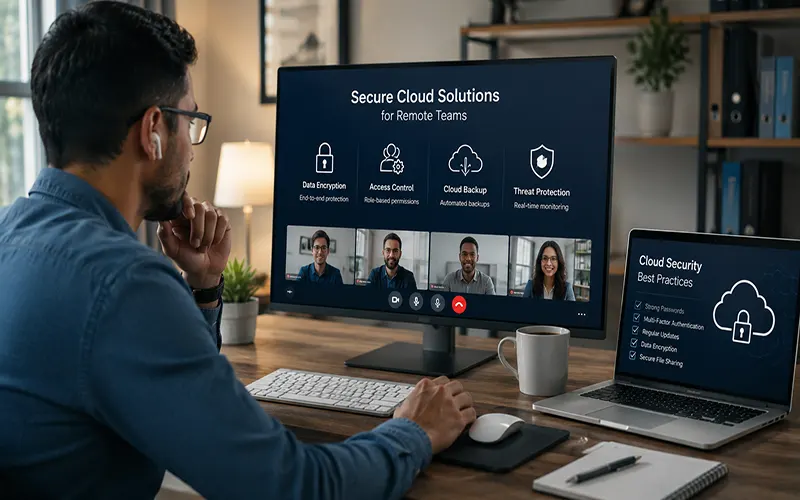
Identity is the new perimeter. Your solution should mandate Multi-Factor Authentication (MFA)—preferably passwordless—and enforce Role-Based Access Control (RBAC). This ensures that employees have access only to the specific tools required for their job, following the “principle of least privilege.”
2. Encryption Standards
Data must be protected at all times. Verify that the provider uses AES-256 encryption for data at rest (stored on servers) and TLS 1.3 for data in transit (moving between the cloud and the remote user).
3. Visibility & Auditing
You cannot secure what you cannot see. The platform must provide real-time logging and session monitoring. Look for Cloud Security Posture Management (CSPM) tools that alert you to misconfigurations or unusual access patterns, such as a login from an impossible location or time.
4. Endpoint Integrity
Before a device touches your company data, the cloud solution should verify its health. Is the OS updated? Does it have active endpoint protection? Is the disk encrypted? If an endpoint fails these checks, it should be denied access automatically.
Cloud Security Evaluation Framework
| Feature | Legacy VPN Approach | Modern ZTNA Approach |
| Trust Model | Trust-based (once inside) | Zero Trust (continuous verification) |
| Access Scope | Full network access | Application-level (per-session) |
| Security Context | Location-based | Identity, device, and behavior-based |
| Visibility | Limited | Comprehensive, real-time logging |
Understanding the Shared Responsibility Model
A critical mistake businesses make is assuming the cloud provider secures everything. In reality, security is a shared responsibility.
- The Provider’s Duty: The Cloud Service Provider (CSP) is responsible for the “security of the cloud”—the physical data centers, hardware, and the underlying virtualization layer.
- Your Duty: You are responsible for “security in the cloud.” This includes managing your users’ identities, configuring access policies, protecting your endpoints, and ensuring that your data is properly classified and encrypted.
Even if you use a high-security SaaS platform, if you fail to enable MFA or leave your data access open to the public, the provider cannot protect you.
Choosing a secure cloud solution is an investment in your company’s long-term operational resilience. By shifting your focus toward identity-centric security, enforcing Zero Trust principles, and acknowledging your side of the shared responsibility model, you transform your remote team from a potential security liability into a secure, agile, and productive workforce.