
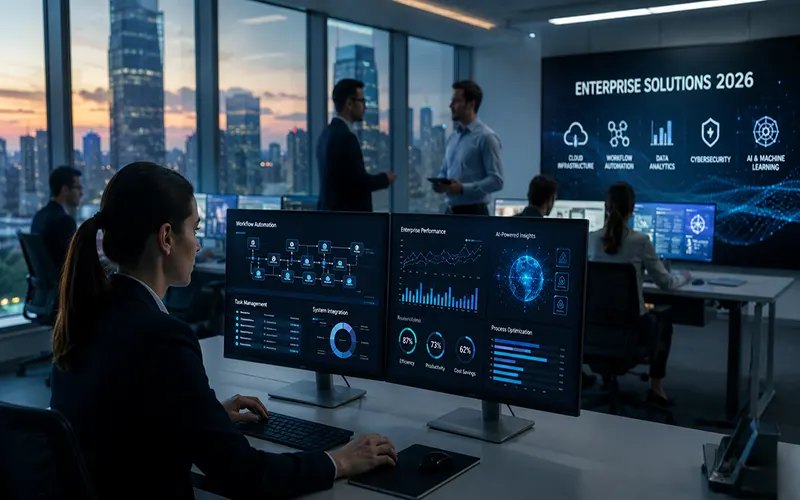
We have reached a definitive “Automation Inflection Point” in 2026. For years, enterprise automation was defined by Robotic Process Automation (RPA)—rule-based scripts that followed rigid “if-then” logic to perform repetitive, low-complexity tasks. While these legacy systems provided efficiency, they were brittle and limited to silos. Today, the landscape has fundamentally shifted toward AI-native, agentic systems capable of orchestrating complex, end-to-end business outcomes.
For enterprise leaders, the objective is no longer just “automating a task”; it is orchestrating intelligent, adaptive business processes. To remain competitive, organizations must move away from fragmented scripts and toward unified computing solutions that treat AI agents as a scalable, digital workforce.
The Shift to Agentic Workflows
The hallmark of the 2026 enterprise architecture is the transition from “task automation” to “process orchestration.” Modern enterprise computing solutions now utilize autonomous agents—intelligent software entities that can interpret unstructured data, make contextual decisions, and interact across multiple systems without human intervention.
Unlike traditional RPA, which breaks when a website UI changes, agentic systems use large language models and vision capabilities to understand the goal of a task. If a CRM interface updates or a data format changes, the agent adapts. This shift enables businesses to automate high-value, cross-functional workflows—such as supply chain logistics, complex lead-to-cash cycles, and autonomous IT incident response—that were previously considered “too human” to automate.
Core Categories of Enterprise Solutions
To achieve this level of operational maturity, enterprises are leveraging three distinct tiers of computing solutions:
1. Unified Orchestration Hubs
These platforms act as the connective tissue for the modern enterprise. Solutions like Workato and ServiceNow serve as centralized orchestration hubs, allowing disparate systems—from ERPs to legacy databases—to communicate fluently. They are essential for enterprises with fragmented tech stacks, providing a single pane of glass to manage complex, multi-system workflows.
2. AI-Native Automation Platforms
For organizations operating within deep ecosystems, vendor-native AI platforms have become the gold standard. Tools like Microsoft Power Automate and Google Vertex AI Agent Builder integrate directly into the cloud infrastructure. These solutions allow developers to deploy sophisticated AI agents that leverage the security, identity management, and data access controls already established within the enterprise cloud environment.
3. Specialized Process/PMO Tools
For highly governed environments, specialized tools like Celoxis or Wrike provide the structure required for heavy-duty project and operations management. These platforms are increasingly embedding autonomous agents to monitor resource allocation, predict project bottlenecks, and automatically reassign tasks based on real-time team capacity.
Selection Criteria: Choosing the Right Automation Engine
| Criteria | Why It Matters | Focus Area |
| Interoperability | Prevents data silos | Connectivity with legacy & cloud systems. |
| Agentic Capability | Enables complex decisions | Cognitive reasoning vs. simple rules. |
| Governance/Audit | Ensures compliance | Logging, observability, and human-in-the-loop. |
| Scalability | Future-proofs operations | Ability to handle volume/complexity growth. |
Strategic Implementation Framework
Implementing an agent-driven automation strategy requires more than just installing software. Enterprise leaders should adopt this four-step roadmap:
- Process Discovery: Utilize process mining tools to identify where your most expensive “bottlenecks” exist. Focus on processes with high human-latency—the areas where data is waiting on a human decision.
- Governance and Guardrails: Autonomous agents require a “Zero-Trust” framework. Define clear operational boundaries, permissions, and audit logs. Every autonomous decision should be traceable.
- Democratization: Leverage low-code/no-code interfaces to empower citizen developers. When domain experts (like HR or Finance heads) can build their own automations, you accelerate innovation across the entire enterprise.
- Continuous Monitoring: Automation is not “set it and forget it.” Use real-time analytics to measure the ROI of your agents. If an agent’s performance deviates from expected KPIs, it should automatically trigger a human review.
Addressing Risk and Security
In an environment where AI agents interact with proprietary data, security is paramount. The primary risk is not just a system failure, but the unauthorized exposure of data. Successful implementation relies on a “Zero-Trust” automation policy—where every agent’s request for data access is verified, authenticated, and logged. Furthermore, enterprises must maintain strict “human-in-the-loop” protocols for high-stakes decisions, ensuring that AI serves as a catalyst for efficiency, not a blind risk.
The enterprise computing solutions of 2026 are not merely tools; they are the foundation of a new, autonomous operational model. Organizations that successfully transition from simple task automation to holistic, agentic orchestration will achieve levels of agility that were previously unimaginable. By prioritizing unified orchestration and robust governance, enterprise leaders can effectively scale their operations, reduce operational friction, and secure a lasting competitive advantage.