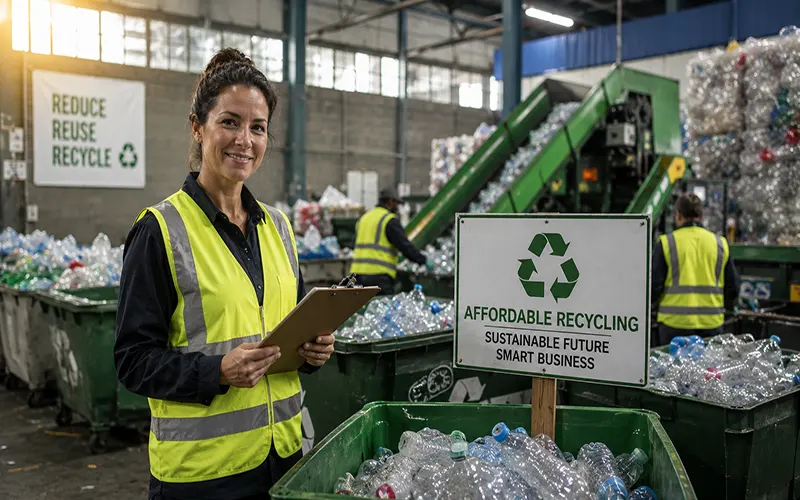
For many small business owners, waste disposal has traditionally been viewed as a fixed cost—a “pay-to-toss” expense that simply grows with your company. However, the paradigm is shifting. As global supply chains and regulatory frameworks move toward a circular economy, businesses that treat waste as a resource rather than a liability are finding significant competitive advantages. By implementing smart recycling strategies, you can reduce landfill taxes, lower your haulage costs, and bolster your brand’s reputation among environmentally conscious customers.
The Plastic Audit: Identifying Value
The first step in your recycling strategy is not calling a waste hauler; it is understanding what you are actually throwing away. Plastic is not a single material, and recyclers value different polymers differently.
Plastic Waste Segregation Guide for SMEs
| Plastic Type | Common Sources | Value for Recyclers |
| PET (#1) | Beverage bottles, food containers | High (Consistent demand) |
| HDPE (#2) | Cleaning jugs, detergent bottles | High (Durable, easy to process) |
| LDPE (#4) | Shrink wrap, bubble wrap, plastic bags | Moderate (Requires clean stream) |
| PP (#5) | Food tubs, bottle caps, straws | Moderate/Low (Volume dependent) |
Pro-Tip: Contamination is the “silent killer” of recycling profitability. A bale of high-quality PET is worthless if it is contaminated with food residue or incompatible polymers. Segregating at the source—ensuring your team separates plastics from paper and organic waste—is the most effective way to keep your recycling stream affordable and accepted.
Finding Affordable Partners
Small businesses often struggle to meet the “minimum volume” requirements that large recycling facilities demand. If you are struggling to find a partner, consider these three strategies:
- Look for Local Aggregators: Instead of targeting massive global waste management firms, look for regional plastic processors or “aggregators.” These smaller operators are often more willing to work with SMEs and have the flexibility to handle smaller, consistent loads.
- The “Directory” Approach: Use professional tools like the Association of Plastic Recyclers (APR) Buyers & Sellers Directory. You can filter by resin type and form (e.g., “baled”) to find partners in your region who specialize in the materials you generate.
- Cooperative Recycling: If your business produces too little plastic for a recycler to pick up, consider partnering with neighboring businesses. By aggregating your waste with other small retailers or manufacturers in your area, you reach the “truckload” threshold necessary to command lower fees or even revenue-sharing.
Optimizing Logistics: The Hidden Cost Driver
Freight is often the most significant barrier to small-business recycling. Transporting air is expensive; when you pay a hauler to pick up loose, bulky plastic, you are paying primarily to move empty space.
The Power of Compaction
Investing in a small, vertical baler can be a transformative decision for your bottom line. By compacting your LDPE film (shrink wrap) or rigid plastics into dense, manageable bales, you achieve two things:
- Space Efficiency: You minimize the storage footprint in your warehouse.
- Transport Value: Recyclers prefer baled material. A neat bale is ready to be fed into a production line, whereas loose waste requires the recycler to pay for labor to sort and process it. In some cases, a well-managed bale of high-value plastic can eliminate disposal fees entirely or even provide a small rebate.
Small Business Implementation Roadmap
- Conduct a Waste Audit: Spend one week tracking your primary waste streams. Identify the top two plastic types you generate.
- Internal Sorting: Set up clear, color-coded bins at the source. Use signage that includes photos of the specific plastic items your team handles to ensure 100% compliance.
- Identify Local Partners: Contact three regional recyclers or use the APR directory to find buyers interested in your specific plastic types.
- Optimize & Schedule: Once you have a partner, discuss the ideal “form” they require. If they prefer bales, look into equipment leasing options for a small baler to reduce your haulage frequency.
Transitioning to an affordable recycling model is not about overnight transformation; it is about “waste resilience.” By focusing on high-value streams, investing in simple compaction equipment, and leveraging local partnerships, you can transform your waste disposal from a shrinking expense into a reliable, sustainable business asset. Your commitment to the circular economy is not just a green initiative—it is a smart, competitive business strategy that positions your company for long-term success.